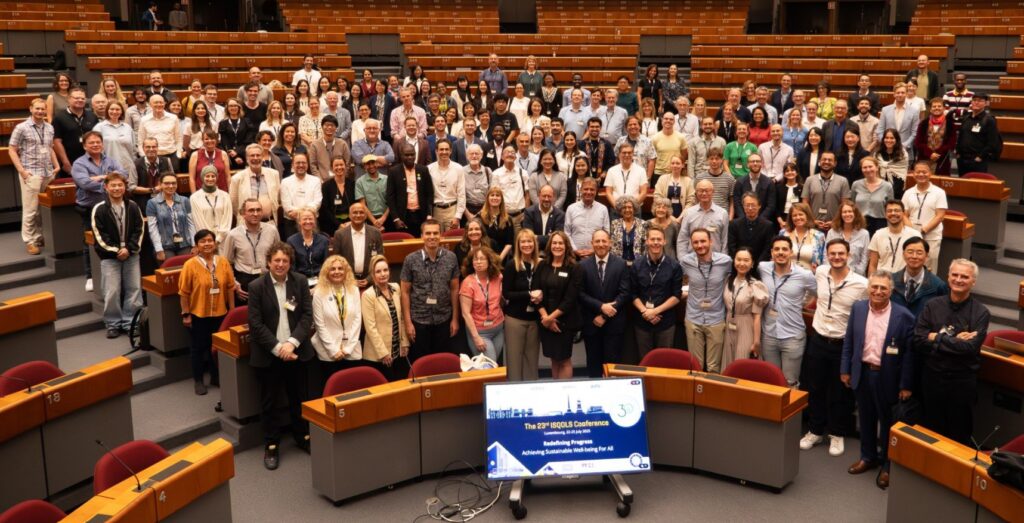
I have been attending ISQOLS (International Society for Quality-of-Life Studies) conferences since 2004 and have been a member of this international society that is dedicated to the cause of providing platform to scholars to disseminate their work in the field of quality of life, happiness, public policy, and global priorities. My interactions with Prof Richard Estes and Prof Joseph Sirgy (the founders of ISQOLS) over the last two decades have taught me values that I can’t express in words. It has strengthened my belief that human well-being and happiness needs to be at the core of policy at national and global level apart from focusing on making people happy at their individual and institutional level. It is an excellent experience listening to global leaders, academicians and policy makers and interacting with them during these conferences. These conferences have provided me opportunity to collaborate with internationally renowned scholars which led to develop a paper on the History of Human Well-Being in South Asia for the volume on Global History of Human Well-Being, published in 2017. Later under their patronage I wrote a full book on Human Well-Being and Policy on South Asia in 2020 which has been received by the international scholars with praise and appreciation.
Attending and presenting at the ISQOLS 2025 Annual Conference in Luxembourg was a deeply enriching experience. The four-day event attracted quality-of-life scholars and practitioners from across the globe, hosted at the European Convention Center Luxembourg (ECCL). The program was packed with plenary lectures, parallel sessions, and special tracks, creating rich opportunities for learning, networking, and academic growth.
As an academic adventurer in the domain of happiness and well-being throughout in the 21st century, here I am just recalling and reflecting on my experience at ISQOLS conference. It is my own experience as an active participant and presenter highlighting not only the major memorial lectures, but also delving into key themes and provocative insights drawn from sessions across different tracks that benefited me directly.
I was honored to present my research during the “Science of Well-being and Well-being of Scientists” session on July 23, 2025, chaired by Tatiana Karabchuk in the room named ‘France’. I presented the work conducted by one of the members of HappLab, Pooja Bansal under my supervision. The paper entitled – Does Teaching Happiness Improve Teacher Well-being? A Case of Government Schools in Delhi, explored how educators’ well-being is affected when happiness is actively taught in schools. The exchange with other presenters—who discussed balancing work-life in academia and the challenges of fieldwork—sparked valuable discussions on how institutional and personal factors influence academic well-being. The notable contribution through our work was that overall, Teachers’ well-being is affected positively, who teach happiness courses.
Apart from my own presentation on the 23rd July 2025, I attended the lectures given by Prof. Sonja Lyubomirsky (Late Edward Diener memorial Lecture); Prof. Richard Layard [Richard J. Estes Lecture]; Prof. John F. Helliwell – Insights from the 2025 World Happiness Report; and Prof. Robert Costanza [Alex C. Michalos Lecture].
Prof Lyubomirsky’s keynote address on the first day [22nd July 2025] entitled – The Science of Happiness: Experimentally Increasing Well-Being Through Gratitude, Kindness, and Conversation Interventions. It underlined how positive activities like gratitude expression, kindness, social interactions consistently enhance subjective well-being. Importantly, she cautioned that the effectiveness depends on tailoring interventions to individual differences and contexts, and warned against potential negative outcomes from indiscriminate pursuit of happiness. This nuance is critical for educators and policymakers designing happiness curricula, confirming the value of contextual sensitivity in well-being programs. Especially striking was her discussion of the “positive activity model”—which helps identify how, why, and for whom happiness interventions work best, and warned of possible unintended effects from indiscriminate pursuit of happiness. She quoted many of the works conducted in her own lab and published in high impact factor journals.
I am proud to say that I have known Prof Richard Layard for several years who has been instrumental in developing policy framework for Happiness ever since he has been a Professor at London School of Economics. At the age of 90+ he seemed academically energetic and inspired; I am sure one can learn a lot by sheer his presence and aura. I had the privilege of interacting with him for last many years. It was a great time that I spent in his company during this conference. This time again he asked me why NSSO is not collecting data on Life Satisfaction of Indian citizens.
His lecture – How Can We Achieve Impact, emphasized the necessity of bringing cost-benefit analysis and wellbeing metrics into the core of policy debate. He argued for simple, clear public messaging (his own initiative like Action for Happiness) and challenged the value of multidimensional approaches in favor of wellbeing (life satisfaction) as a universal benefit metric. This session broadened my perspective on how research can directly inform evidence-based policymaking across diverse policy areas.
Presenting with Sara Konrath, Prof John Helliwell [known for drafting World Happiness Report ever since its inception in 2012] drew on the latest World Happiness Report to examine how caring and sharing globally drive happiness trends. Particularly salient was the research linking social connectedness, meal sharing, and prosocial behaviors to both individual joy and reductions in societal “deaths of despair”. These findings strongly echo the practical benefits discussed during my session, showing how policy and community initiatives can be designed around cultivating compassion, purpose, and social bonds. This time he made online presentation. I remember meeting him few times before when I shared with him my concern about unfair representation of India in the World Happiness Report.
Another keynote that I can never forget was given by Prof Robert Costanza [Alex C. Michalos Lecture] on the 25th July 2025 on – Creating a Sustainable Wellbeing Future for Humans and the Rest of Nature. He confronted the challenges posed by the fossil-fuel-driven development paradigm. He sharply critiqued the “addiction” to fossil-fuel-driven GDP growth, proposing a radical systems approach that evaluates natural and social capital as central drivers of sustainable well-being. He advocated for a systems approach recognizing natural and social capital and stressed the importance of modelling and valuing the diverse drivers of sustainable and inclusive wellbeing. His lecture reinforced the conference’s central theme: that transitioning to wellbeing-centred economies demands interdisciplinary strategies, robust measurement systems, and collective action. I really loved his presentation that voiced for an interdisciplinary collaboration to transition towards economies where human and planetary flourishing are intertwined.
Apart from the above keynote addresses I prioritized Happiness at work, Well-being beyond GDP, Urban Planning, and Science of Happiness sessions as it was not possible to attend all sessions as there were around 10-11 parallel sessions running in different rooms.
Across several sessions—including Beyond GDP; Special Session on Citizen-led Approaches to Going Beyond GDP; and Well-being Value for Money – the presenters debated the future of well-being measurement. There was interesting discussion on the frameworks that move beyond income or aggregate productivity, arguing for inclusive indices that synthesize subjective well-being, social equity, sustainability, and local values. There was rich discussion about qualitative and quantitative progress indicators, emphasizing regional and demographic disparities.
Sessions such as Well-being and Pro-social Behavior; Community Indicators Projects; and Social Capital and Well-being repeatedly highlighted the vital role of trust, civic engagement, volunteering, and community bonds in fostering well-being. Both empirical papers and conceptual panels pointed to the positive psychological and health impacts of volunteering, altruistic behavior, and friendship networks. In one especially compelling analysis, social isolation across life stages was shown to undermine perceived capabilities and life satisfaction.
Multiple tracks explored how well-being varies across demographics, regions, and social strata:
- Urban vs. Rural Well-being and Environment: Panellists examined differential happiness gradients between urban and rural populations, with studies emphasizing place attachment, environmental quality, and spatial inequalities.
- Gender and Disability: Dedicated sessions reported on the paradoxes and challenges faced by women and people with disabilities. Discussions scrutinized gender differences in happiness and workplace outcomes, as well as how intersectional approaches can better address cross-cutting sources of ill-being.
- Migration and Cultural Integration: Key presentations probed how cultural adaptation, migratory experiences, and inclusive local policies directly shape subjective well-being counts.
The session on Economics of Happiness and Labor and Workplace Well-being focused on the deep links between workplace environments, job satisfaction, job loss, economic status, and overall life satisfaction. Some of the notable findings included:
- The impact of hybrid and remote work arrangements on well-being, both positive (greater flexibility) and negative (risk of isolation).
- Studies on workplace conflict, organizational citizenship, job insecurity, and process transformation illuminated pathways to enhance well-being through psychological safety, dialogue, and supportive leadership.
Tracks on Ill-being; Health and Well-being; and (Late) Ronald E. Anderson Endowed Track on Alleviation of Human Suffering made it clear that well-being research must also address suffering, trauma, and adversity. I got reminded of my interaction with Ron Anderson when he was alive and we were exploring the link between suffering and life satisfaction. It was a perfect homage to his contribution. The presenters discussed interventions for vulnerable groups such as those facing chronic illness, poverty, war-related trauma, and discrimination, offering insights into effective support systems, policy mechanisms, and resilience-building approaches.
There were interesting papers on Environment and Sustainability that underlined the need to harmonize well-being with planetary health. The studies on local air quality and nature connection demonstrated significant associations with life satisfaction. Some of the innovative Delphi studies revealed international consensus on sustainable pathways for human and planetary flourishing. I had lot of appreciation and endorsement of views when the panelists debated “degrowth” and happiness, emphasizing that economic progress should not come at the expense of natural capital or social cohesion, which was also highlighted by Prof Costanza in his plenary lecture.
From opening reception to the final conference dinner celebrating ISQOLS’ 30th anniversary, the informal exchanges provided genuine opportunities to build professional relationships. Dialogues with scholars from diverse disciplines and geographies enriched my appreciation for the variety of conceptualizations and methodologies in well-being studies.
Whether discussing indicators with economists, interventions with psychologists, or models with sustainability advocates, the conference flourished as a space for synthesis across disciplines, often leading to the creative rethinking of previously accepted paradigms. The sessions organized around local case studies, participatory research, and citizen-led measurement frameworks brought practitioner expertise to the academic discourse, ensuring that research remains relevant to those working directly with communities in promoting well-being.
Based on my participation, interactions, and learning, I think there could be possibly some actionable takeaways as mentioned below:
- Policy Impact: Well-being metrics, when robustly integrated into policy design and evaluation, can shift government priorities toward more humane and effective outcomes.
- Contextual Sensitivity: Both interventions and measurement frameworks must reflect local cultural, social, and environmental contexts to optimize impact.
- Interconnectedness: Academic research benefits from dialogue across fields – education, economics, health, urban planning, sustainability – mirroring the inherent interconnectedness of human well-being.
- Measurement Matters: Advances in multidimensional indices and AI-powered tools promise greater accuracy, inclusivity, and responsiveness in well-being tracking.
- Resilience and Compassion: Programs that build social capital and promote resilience (through community engagement, education, and targeted supports) are essential for addressing persistent sources of ill-being.
Attending ISQOLS 2025 has reaffirmed my conviction in the transformative power of happiness science, not only as an object of academic inquiry, but as a lever for tangible societal improvement. The wealth of research presented spanned the micro (individual, family, classroom) to the macro (national and planetary policy), constantly underscored by contributions from leading scholars and trailblazing practitioners.
Presenting my own findings and learning from global perspectives has sharpened my understanding of the subtlety and complexity involved in advancing well-being. We are not only measuring happiness but also defining the parameters for just, inclusive, and sustainable human well-being. However, a question keeps haunting me that can we really measure and compare level of happiness across geographies and communities, professions and populations.
The ISQOLS 2025 Annual Conference brought together a kaleidoscope of insights and evidence, confirming that well-being is a unifying but complicated challenge for our era. Combining rigorous academic research, innovative methodologies, policy analysis, and grassroots participation, the conference mapped out actionable pathways toward a future where happiness is both a legitimate end and a practical means for collective progress. As the field moves forward, it will be essential to maintain this spirit of interdisciplinarity and reflexivity, ensuring that quality of life studies remain adaptive, inclusive, and impactful for individuals, communities, and societies everywhere.
This time it was quite interesting to see so many participants from India unlike the other ISQOLS conferences that I have attended earlier. This is a positive sign for identifying and rethinking on priorities for a better country. It was heartening to note that there are several Indian institutions that are academically supporting and providing financial support for the studies in the domain of quality of life, human well-being, life satisfaction, subjective well-being, and happiness.
I wish we organize a conference of this stature, size, and quality in India sometime in the coming future to build a strong case of Indian conception of Happiness and/or Aanand and to draw attention of happiness scholars to the fact the World Happiness Report does not truly represent India.

1 thought on “MY EXPERIENCE AT THE 23rd ISQOLS ANNUAL INT CONFERENCE AT LUXEMBOURG”
Really Insightful Respected Sir 🙏💐