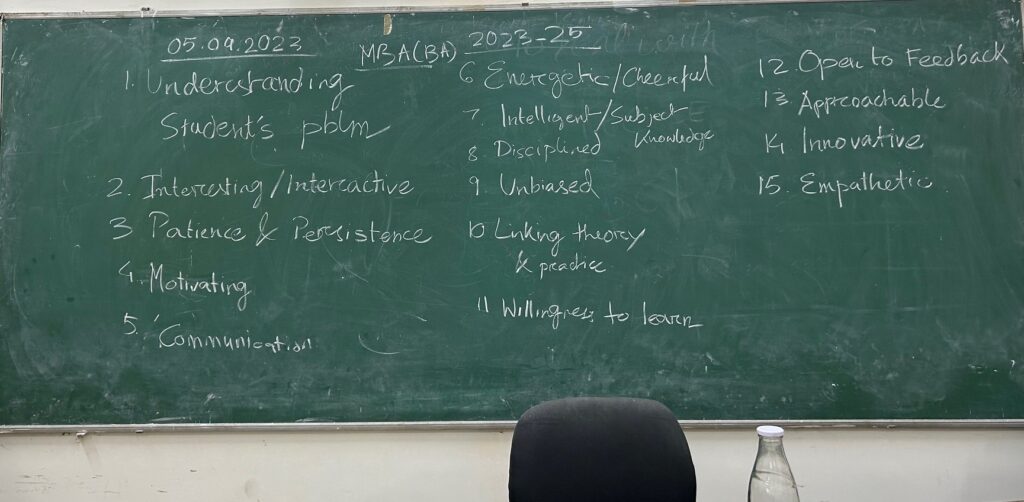
Each Teachers’ Day, usually whenever I have my regular classes, I am drawn to reflect not just on the profession, but on the deeper meaning that “teacher,” “teaching,” and “education” hold in a rapidly changing world. This year 5th September was a holiday and I missed meeting dear students. Yet I recall my past teachers’ day interactions with the students, in Delhi or Shillong, Bhutan or Bhimtal.
Every year on 5th September, I am deeply touched to receive warm greetings, heartfelt messages, emails, and calls from my students—each one bringing a unique sense of joy and fulfillment to my life as a teacher. Positions don’t matter, teacher does!
I count myself fortunate—perhaps even blessed—to be constantly renewed through dialogues with my students: their questions, observations, and honest feedback offering mirrors in which I see both my strengths and my shortcomings.
The classroom, for me, is more than a physical or virtual space; it is a crucible where worldviews are tested, where curiosity is both nurtured and challenged. As I ask my students, “What do you expect from a teacher?” their answers inevitably return to first principles: commitment, dedication, honesty, and open-mindedness. These are not ephemeral ideals, but the substance that forms teaching’s backbone.
It is a powerful reminder: Teachers have the capacity to shape or shatter generations, to inspire students to quest further and question more deeply, or to close doors with indifference. If education is to become the platform that helps each learner discover themselves, then the teacher’s role is nothing less than that of a catalyst—one who sets the reaction in motion, but does not determine the outcome.
Commitment to teaching is, for me, far more than the fulfillment of duty. It shows itself in the energy I bring to each session, the sincerity with which I answer questions, and the perseverance with which I seek to improve. Students recognize and respond to such investment: it signals that their development matters, that their time is valuable. True dedication finds expression in both big gestures—innovating curriculum, championing student needs—and small ones, like timely feedback or an encouraging word after class.
My classroom’s diversity enriches me every day. Students value open-mindedness not just as a concept, but as daily practice. This means being willing to listen, admit what I do not know, and sometimes, to let go of “how things have always been done.” Accessibility goes beyond posted office hours; it means cultivating a climate of approachability, one where students feel comfortable approaching me with uncertainties, ideas, and feedback.
Nearly every student group identifies the “urge to learn” as a core expectation. In today’s context, with AI and digital technologies transforming higher education, I believe teachers must embody the spirit of lifelong learners. No longer can we rest on degrees or prior expertise alone. By reading widely, attending to conversations and being part of them, engaging with new pedagogies and platforms, teachers demonstrate both humility and relevance. Such a posture models adaptability for students preparing to navigate a world of constant change.
My own love for books shapes how I teach—and my students notice. Regular reading not only broadens one’s perspective but allows the integration of stories, examples, and case studies that deepen learning. Communication, students observe, is about more than delivering content. It means making topics relatable—sometimes by sharing personal experiences, or by linking theory to contemporary issues.

No technological advance can replace a teacher’s kindness or patience. For every student who excels, there is one who struggles silently. My ability to offer encouragement, to listen without judgment, or to patiently explain a concept for the third time is sometimes what transforms reluctance into enthusiasm. Motivation is closely linked: when I demonstrate faith in students’ capacity to grow, they come to believe in themselves.
Students often speak of a teacher’s “lively” personality—the quality that turns a class into a space of joy and engagement. But this liveliness is always tempered by discipline: punctuality, preparedness, and follow-through. These habits, I’ve learned, earn credibility and respect.
In a field where assessment and evaluation are daily realities, impartiality and honesty become guiding lights. Students, acutely sensitive to fairness, value teachers who are forthright and transparent. Academic integrity—resisting shortcuts and upholding standards—even when inconvenient, shapes a culture where learning and merit can thrive.
As education is rapidly digitized and AI disrupts traditional roles, the expectations from teachers have become multi-layered. Beyond subject expertise, we are now facilitators of digital literacy and ethical discernment. How do we model critical thinking in an age of algorithmic bias? How do we maintain human connection across screens? Lifelong upskilling is not optional—it is essential for relevance.
But technology is not the threat; it is a tool—one that, wisely wielded, can free up time for deeper engagement, enable inclusion, and democratize access. Instead of fearing replacement, I see my role as one of augmentation: focusing ever more keenly on those human aspects—empathy, ethical leadership, care—that AI cannot emulate.
Education is society’s greatest lever for enduring progress. The teacher, then, is a responsible partner of the state, not just an employee of an institution. By fostering critical thinking, ethical citizenship, and adaptive skills, we invest in the nation’s future. As knowledge continues to evolve, the teacher’s role in preparing students as thoughtful, ethical, and inventive contributors is more urgent than ever.
Each time I reflect, as my blog recounts, I am reminded that teaching is as much about self-discovery as it is about imparting knowledge. It prompts a recurring question: “Do I possess the qualities I expect of a good teacher?” This perpetual introspection is the mark of an evolving teacher—never satisfied, always searching. My students, in sharing their expectations, challenge me to look within, stretch further, and serve more sincerely.
To be a teacher is to straddle the old and new, tradition and transformation, certainty, and wonder. No single quality suffices; it is their interplay—commitment, kindness, discipline, learning, and open-heartedness—that forges lasting influence. On this Teachers’ Day, I am profoundly grateful for every teacher and student who has shaped my path. May we all, on both sides of the desk, continue to learn, reflect, and build a future powered by knowledge, character, and compassion.
===
also read:

2 thoughts on “ON TEACHERS’ DAY 2025”
I have enjoyed reading the feature. No pre conceived notions, no emotions pure feelings. Thank.
Seeing the picture of the board and reading this article brings back so many wonderful memories!
I remember sitting in this class—this exercise was truly fun and engaging.
Having been taught by so many teachers during my Engineering and MBA, I found this activity uniquely impactful. It was heartwarming to see how you celebrated Teacher’s Day by embracing the expectations of your students. This is truly remarkable, and I am grateful to have been your student.